![Logo - Full Color-1.svg]](https://help.letshighlight.com/hubfs/Logo%20-%20Full%20Color-1.svg)
In order to begin creating your project's instructions, you'll need to finalize your project's products, audience, and surveys. When you land on instructions, you will see the Test Groups you've created in the "Audience" step broken down into sub-groups. We call these "variants". We create a variant for each product rotation possibility within a Test Group. We also create a variant if you've selected any Add-On Activities in a Test Group.
Take a look at the example below:
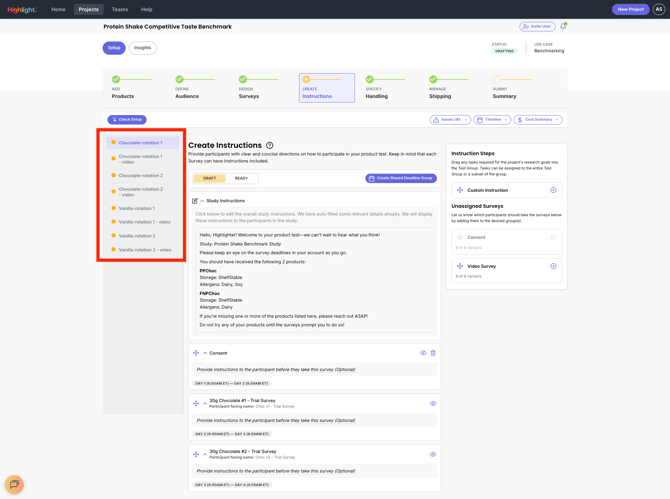
In this example:
- There are two Test Groups: Chocolate and Vanilla
- In each Test Group, there are two products getting randomly rotated. Accordingly, we create two variants to capture each rotation.
- In each Test Group, a subset of participants are also supposed to submit a video response. We create two variants for these, as well.
You can then go through and input the exact instructions you need a participant in a given variant to follow.
- Include which surveys to take and when to take them
- Survey(s) directly associated with a product in the Test Group are default included and cannot be removed
- Any other surveys you've created for the project can be dragged in and added to the variant (e.g. a Final Wrap-Up Survey or Video Survey)
- Drag around and order when participants in a variant should take each survey
- Add any mandatory "Custom Instructions" periods
- "Wait" or "Try Product" period
- These denote points in time when the participant is not meant to be responding to a survey, but instead testing a product or taking a break from testing
- Input instructions content
- Overall instructions — what should participants know in general about the study and how they should test?
- Instructions particular to a specific step — what should participants do or understand at a given point in the project?
In the sections below, we'll illustrate how you might interact with each of these aspects of instructions outlined above and call out important details to keep in mind.
Include which surveys to take and when to take them
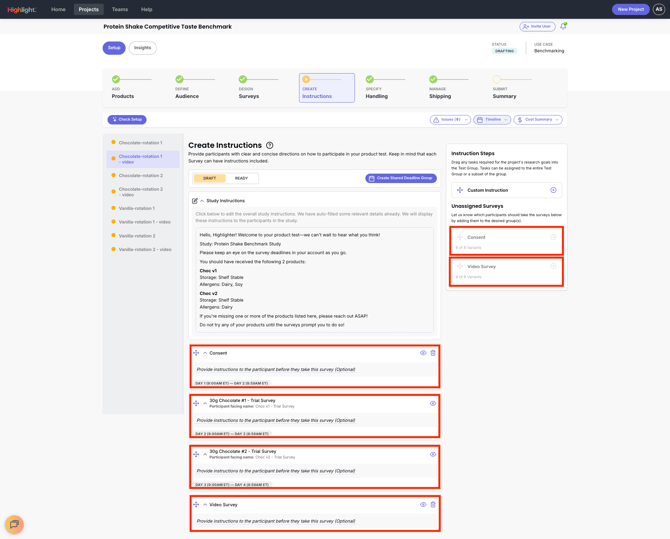
- The annotations in the screenshot above show the surveys available in this variant. Note that the survey names you see here will be the survey names shown to participants.
-
This variant is a part of the Chocolate Test Group, so by default, it included the two Trial Surveys associated with the two Chocolate products participants in this group will be testing.
- This variant represents one rotation for the Chocolate Test Group, so the "30g Chocolate #1" survey is going to come before the "30g Chocolate #2" survey. In the variant for the second rotation, this order would be flipped.
- Additionally, since this variant is for participants submitting a video, I dragged in the "Video Survey" from the "Unassigned Surveys" bank on the right. I also need all participants to formally agree to being in the project, so I've dragged in the "Consent" survey.
- I need the "Consent" survey to be completed first, followed by the two product surveys, with the "Video Survey" coming at the end. I can drag and drop each survey as needed into the desired slot.
- Note the
Day x - Day ylabels that appear within each step tile — these let you know on which day of the study the participant will have access to the survey and when it is due. The box delivery date is considered Day 1. Think about the total duration (i.e. number of days) that you'd like a participant to be in the study to ensure you're designing your instructions as desired. - By default, each step is its own day. For example, the "30g Chocolate #1" survey is due on one day, and the "30g Chocolate #2" survey is due on another day. If you need multiple surveys to be completed on the same day, use the "Shared Deadline Group" feature — you can read full details on how that feature works in the last section of this article!
Add any mandatory "Custom Instructions" periods
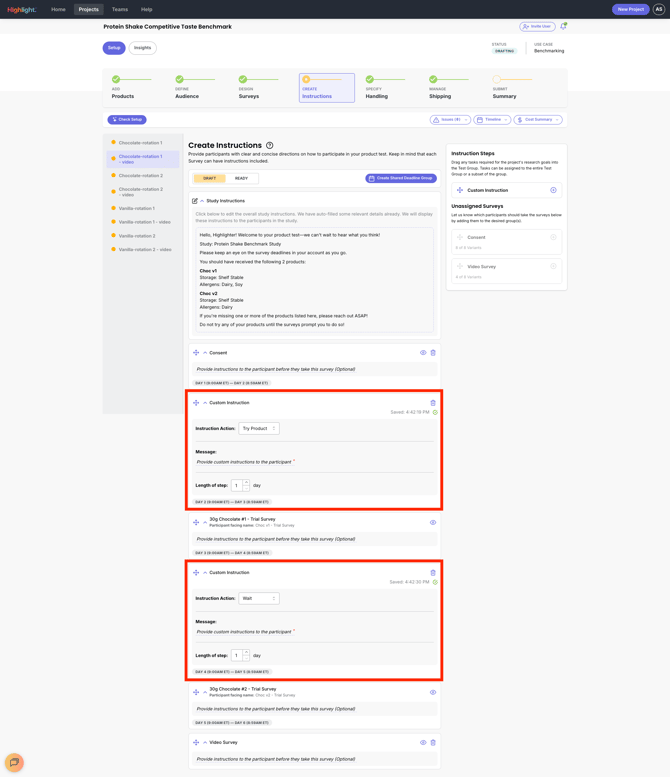
- Say you wanted to ensure that participants spent at least a certain amount of time (1 or more days) trying or testing the product before being able to provide feedback. You can drag in a "Custom Instruction" > "Try Product" step to enforce.
- Note: If you'd like the participant to be able to take the survey right away — either immediately after or while trying the product — you can add those instructions to the survey step itself. The "Custom Instruction" > "Try Product" step is only necessary if you need participants to take at least 1 day to try the product before having the chance to answer a survey.
- Similarly, say you wanted participants to take a certain amount of time (1 or more days) off from testing. You do not want them to test products — maybe you want them to cool off and go about their normal lives before going to the next product — and you don't want them to take a survey, either. You can drag in a "Custom Instruction" > "Wait" step to enforce.
Input instructions content
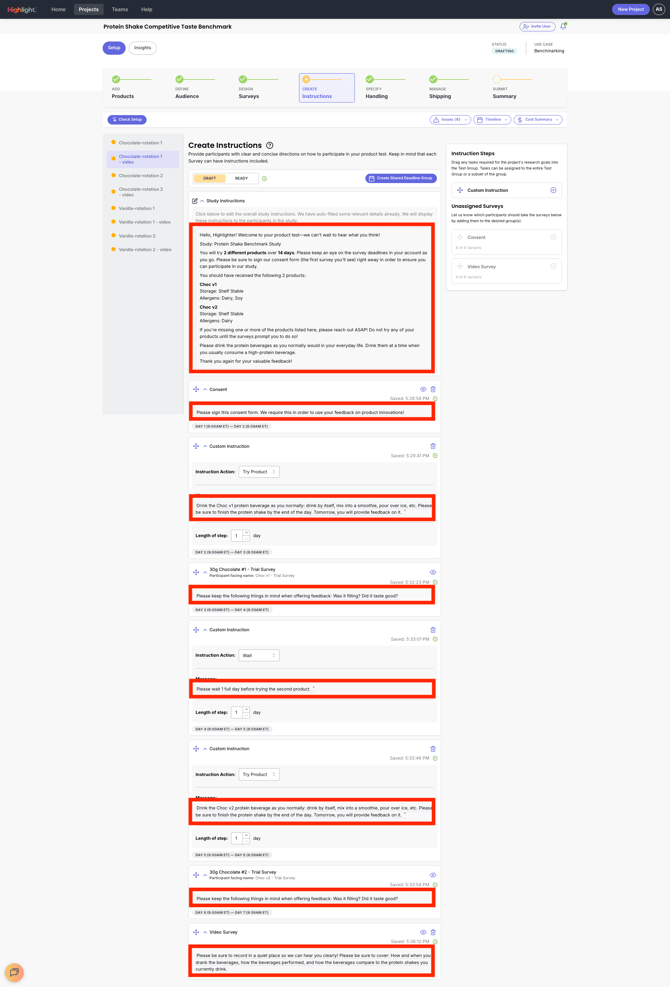
- The annotations in the screenshot above show edits made to the overall instructions and per-step instructions.
- Below are some tips and best practices to follow in order to ensure sound research. For more detailed guidance on how to write clear and effective participant instructions, see our article on Writing Effective Participant Instructions.
- Make sure participants understand the general structure of the project: How long it will last, how many products they'll test, etc. If the overall structure is unclear, participants may rush, delay, or misuse products, reducing comparability across respondents.
- Participants need to know the required testing duration for the product, and whether a break is required before moving to another product (if applicable). Participants should know exactly how long they are expected to use the product before providing feedback. In multi-product studies, unclear duration can lead to some products being under-tested while others are over-used, making comparisons unreliable. Being explicit about duration helps ensure consistent exposure across participants and supports more accurate evaluation.
- Participants must understand how to use the product correctly (i.e. how to use, consume, or apply the product, and how often to use it).
- Participants must be clear on how to store and handle the product. If storage conditions matter, clearly communicate them. Improper storage and handling can alter product performance and confound results.
Highlighting the "Shared Deadline Group" feature
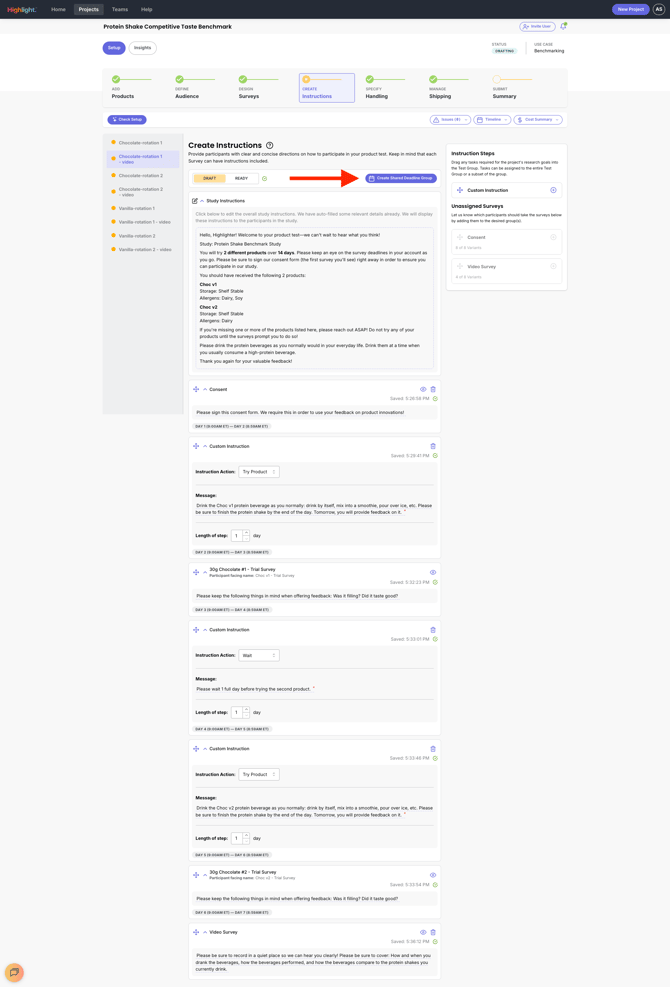
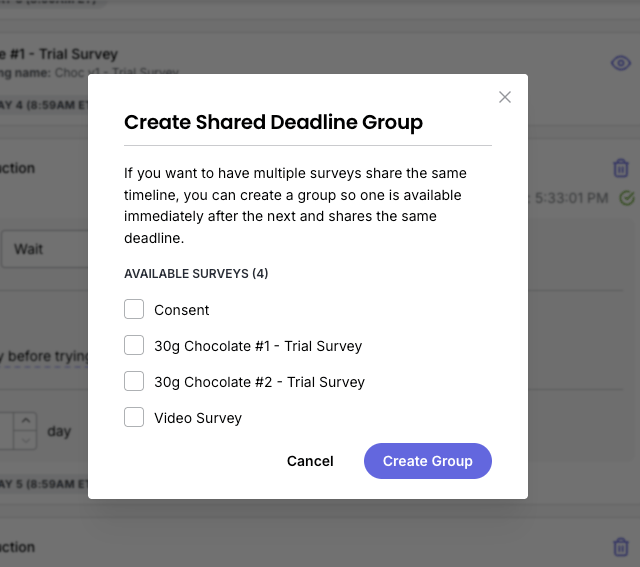
- If you need participants to respond to multiple surveys by the same day — or you need them to respond to them one after the other, immediately — create a Shared Deadline Group.
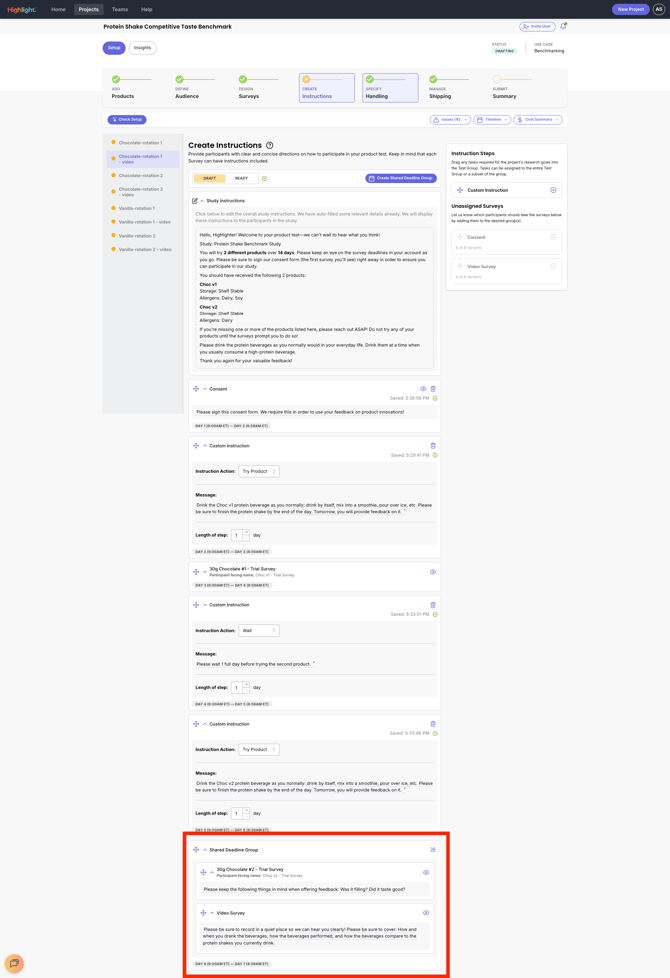
- You can select the surveys you'd like to share a deadline, and participants will be prompted to respond to each by that same day in the study. They will have access to the second survey in the group immediately after completing the first (and so on and so forth).
- The screenshots above exemplify a use case for this feature. Maybe I want the participants to submit their last product trial survey (for the "Choc v2" product) and the video survey on the last day. And maybe I want them to submit the video survey immediately after "Choc v2" survey because I want to capture their video response while everything is still fresh in their mind.
- You can drag a Shared Deadline Group anywhere you'd like. You can create as many as you need.