![Logo - Full Color-1.svg]](https://help.letshighlight.com/hubfs/Logo%20-%20Full%20Color-1.svg)
Insights professionals and product researchers often need to answer questions like which of several product features matter most to customers? Which concept or design is most appealing? Which combination of products will reach the most people?
Two market research techniques that help answer these questions are MaxDiff (Best–Worst scaling) and TURF analysis. While they sound technical, the concepts are quite straightforward once you see how they work! This guide explains what they are, when to use them, and how they can support research throughout the new product development (NPD) lifecycle.
What is MaxDiff (Best–Worst Scaling)?
MaxDiff—short for Maximum Difference Scaling—is a survey technique where respondents choose the most appealing (best) and least appealing (worst) option from a list. MaxDiff typically requires 8 to 40 items (attributes or features) for an effective study, though it can handle up to hundreds. It is best suited for comparing more than 6 items where direct ranking becomes too difficult for respondents.
Instead of asking people to rate items on a scale from 1–10 (where many items often get similar scores), MaxDiff forces respondents to make clear trade-offs. This produces more reliable insights about relative preference and importance. MaxDiff is especially useful when respondents must choose between competing ideas or attributes.
MaxDiff is ideal when you want to understand from a list of 8-40 features, concepts, messages, packaging design, or product attributes which are preferred, most appealing, effective, or attractive.
MaxDiff can support several stages of the product development lifecycle and help teams focus on what truly matters!
- Idea Prioritization. Identify which product ideas or benefits resonate most with consumers.
- Concept Development. Compare multiple product concepts to see which has the strongest appeal.
- Product Design. Understand which features customers care about most.
- Packaging and Messaging. Test packaging claims or marketing messages.
- Go-to-Market Strategy. Prioritize the features and benefits to emphasize in marketing.
Example of a MaxDiff Question
Imagine a beverage company exploring features for a new soda. A MaxDiff survey module might look like this:
Screen 1 -
Which feature is MOST appealing and which is LEAST appealing?
- Natural fruit ingredients
- Low sugar
- Eco-friendly packaging
- Added vitamins
The consumer selects:
- Best: Natural fruit ingredients
- Worst: Added vitamins
In the next screen, the same question shows up but the list changes slightly. After several screens, researchers can determine which features consistently rise to the top and which fall to the bottom. The result is a clear ranking of what matters most to consumers.
Key Guidelines for Designing a MaxDiff Study
Design matters in MaxDiff research to ensure reliable results and a good respondent experience.
Number of Items and Screens
Highlight recommends that a MaxDiff study test 8–40 items.
A simple formula is used to determine the number of screens.
Number of Screens = (Total Items × Desired Appearances per Item) ÷ Items per Screen
Where:
- Total Items = number of concepts/features/messages you want to test
- Desired Appearances per Item = 2
- Items per Screen = 4
- Number of screens (tasks) = 4-20 (depending on number of total items)
Anchoring
In some cases, Highlight may recommend using Anchored MaxDiff to build on a standard MaxDiff exercise.
As you now know, a typical MaxDiff study tells you how items compare to each other (for example, which features are more or less preferred relative to others). However, it doesn’t tell you whether those items are actually important on their own. Anchored MaxDiff helps fill in that gap by adding an extra layer of insight.
With Anchored MaxDiff, we include 1 additional question alongside the standard MaxDiff tasks. This question uses a simple rating scale (like a 5-point scale) tied to a key outcome metric, such as importance or preference. This helps us understand how strongly people feel about the items overall—not just how they rank them against each other.
Here’s how it works in practice:
After each MaxDiff question, respondents are asked a follow-up question about the group of items they just saw. For example, they might be asked whether:
- All of the items shown are important or appealing
- Some are important or appealing, and some are not
- None of the items are important or appealing
These responses are then included in the analysis. They help us identify a clear “cutoff point” between what people truly consider important and what they don’t. This approach is especially helpful when respondents vary widely in how engaged they are or how strongly they feel, as it makes the results more stable and easier to interpret.
Stimulus
Clear and consistent stimuli presentation is critical - ensure product concepts are concise (1-2 line text description with an optional image/ packshot) to avoid overwhelming respondents as they evaluate multiple different ideas.
Base or sample (n=) size
A MaxDiff study is a quantitative assessment and typically requires n=500 in total sample size for robust results. You may consider n=1000 if you are planning to review results in Total and by key subgroup. Highlight recommends a minimum of n=200 for any individual cohort / subgroup.
MaxDiff vs. Conjoint Analysis
MaxDiff is often mentioned alongside conjoint analysis, but the two methods answer different types of questions.
MaxDiff: which product feature matters most?
- Ranks individual attributes or options
- Best for understanding relative importance or preference
Conjoint Analysis: which combination of features and price would people buy?
- Evaluates combinations of attributes
- Used to simulate real purchase decisions
- Often used to estimate price sensitivity and market share
While Highlight does not offer Conjoint analysis currently, we do offer TURF analysis as a common add-on to a MaxDiff study.
What is TURF Analysis?
TURF stands for Total Unduplicated Reach and Frequency. TURF analysis helps determine which combination of products, features, or concepts will reach the largest number of consumers.
TURF looks beyond simple popularity to determine which combination appeals to the widest audience.
For example, imagine a restaurant choosing ice cream flavors. If they only look at popularity, they might choose Chocolate and Vanilla. But a TURF analysis might show something different: Chocolate appeals to one group and Strawberry appeals to another group. Offering Chocolate + Strawberry might reach more total customers because the audiences are different.
This helps businesses maximize market reach rather than just choosing the top-ranked options!
Key TURF Outputs
TURF analysis produces several helpful metrics.
- Total Reach: The percentage of consumers who like at least one item in a combination.
- Frequency: How many items within the combination each person likes.
- Unique Reach: The percentage of new consumers added by including an additional item. (Usually represented as a % of total sample)
Example:
|
Individual Flavor |
Unique Reach |
|
Vanilla |
80% |
|
Chocolate |
85% |
|
Strawberry |
70% |
|
Flavor Combination |
Total Reach |
|
Chocolate + Vanilla |
65% |
|
Chocolate + Strawberry |
78% |
Even though vanilla is more popular individually, strawberry expands reach by attracting different customers.
When to Use TURF
TURF is particularly valuable for portfolio optimization decisions, such as:
- Product line development/ extension
- Retail assortment planning
- Menu design
- Content selection
- Feature bundles
It answers the question: “Which combination will reach the most customers?”
MaxDiff + TURF: A Powerful Combination
When used together, MaxDiff and TURF provide both depth and strategy.
MaxDiff answers: What do people like most?
TURF answers: Which combination reaches the most people?
This combination helps organizations make smarter decisions about product portfolios, feature prioritization, assortment planning, and messaging strategies.
Example Deliverables
Highlight offers two types of MaxDiff + TURF outputs. These tools allow stakeholders to explore scenarios and make informed decisions.
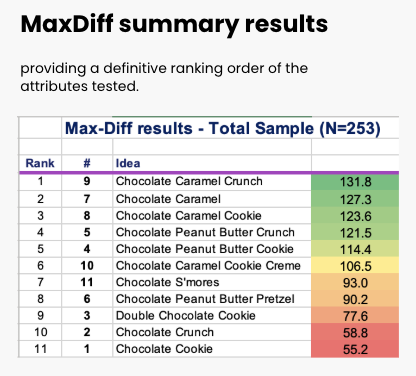
- MaxDiff + TURF Excel Simulator
- Interactive Excel tool
- Allows users to test different combinations
- Supports analysis for up to 3 subgroups
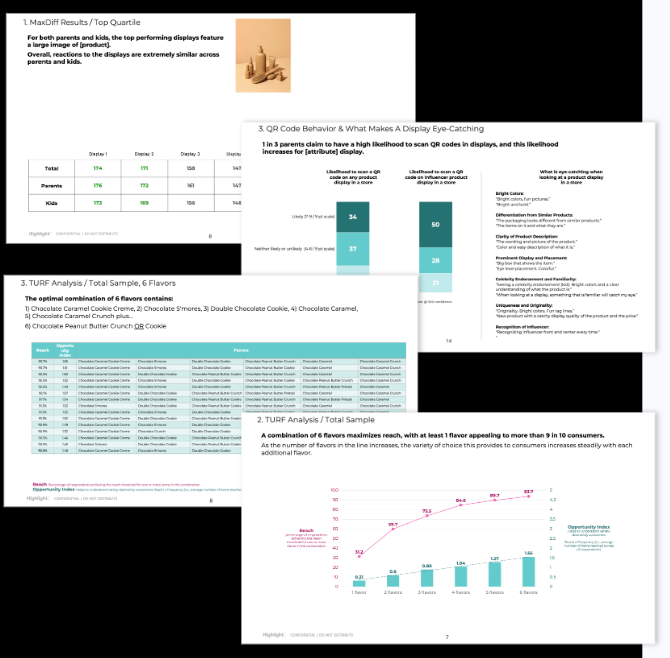
- MaxDiff + TURF PPT and Simulator Package
- Excel simulator
- PowerPoint report (up to 20 slides)
- Analysis across up to 3 subgroups
TURF Simulator
TURF analysis is typically explored through a simulator tool that breaks down how each metric contributes to overall performance. The example below shows how a TURF simulator brings the metrics to life.
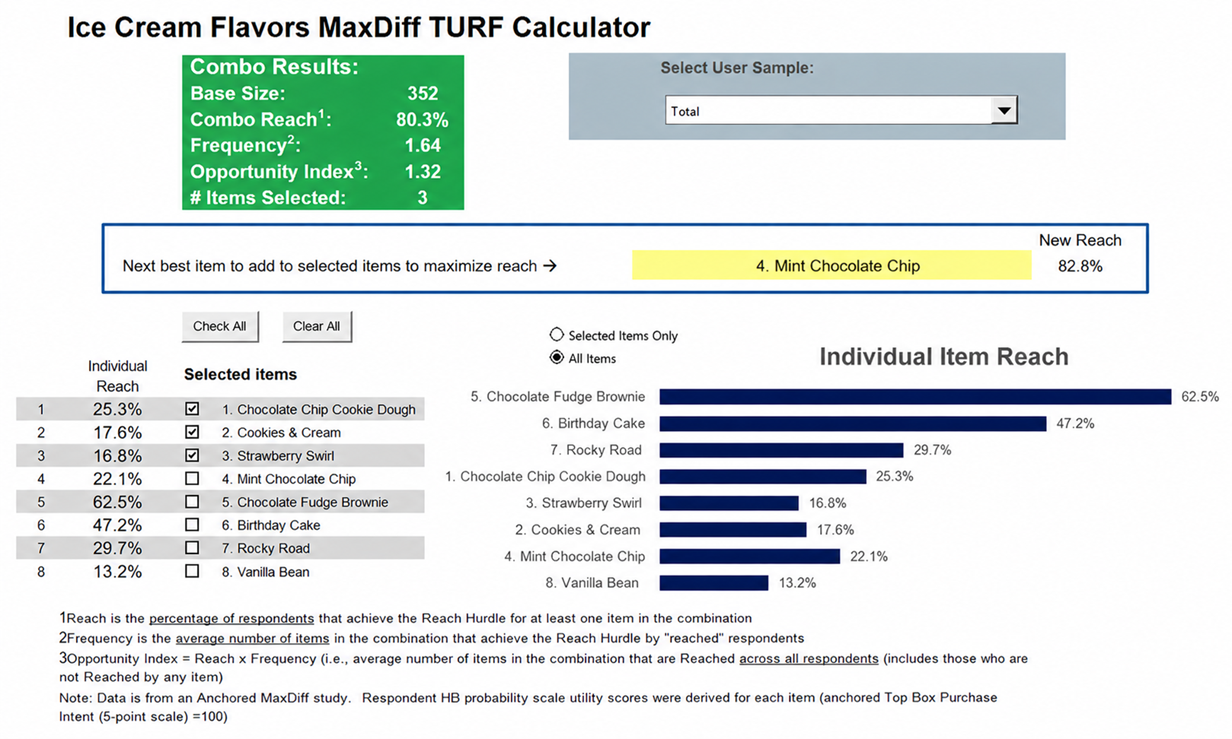
In the example, we have selected a line of 3 ice cream flavors: Chocolate Chip Cookie Dough, Cookies & Cream and Strawberry Swirl.
- User Sample represents the sample included in the analysis and can be viewed overall (total) or broken out by key subgroups (e.g., age, gender) to uncover differences across audiences.
- Combo Reach highlights the percentage of consumers reached by the selected set (Chocolate Chip Cookie Dough, Cookies & Cream and Strawberry Swirl). In this example, it would be expected that 80.3% of target consumers would be interested in at least 1 of the 3 selected flavors. Some may be interested in 2 or 3 of the selected flavors, but all 80.3% would be interested in at least 1.
- Frequency shows how many of those options each consumer prefers. As mentioned above, respondents may be interested in 1, 2 or all 3 flavors in this example. The Frequency measure tells us, on average, how many of the 3 selected flavors respondents are interested in. In this case, it is 1.64 – in other words, the average respondent would be interested in around 2 of the 3 flavors.
- Opportunity Index combines both to reflect overall portfolio strength. This measure is simply a combination of the Combo Reach and Frequency, calculated by multiplying the two together (i.e., 0.803 x 1.64 = 1.32). By factoring together both Combo Reach and Frequency we get a single number to help us interpret assortment performance.
- Next Best Item identifies the next best flavor that could be added to the line to expand reach without redundancy. In this example, a 3 flavor line of Chocolate Chip Cookie Dough, Cookies & Cream and Strawberry Swirl reaches 80.3% of respondents, and if we want to add a 4th flavor to the line that maximizes reach for the portfolio, the next best choice would be Mint Chocolate Chip (which if selected would increase Reach to 82.8%).
- Individual Item Reach shows the reach of each flavor by itself, as if it were the only flavor in the line. As we add or delete flavors from the line these figures will not change.
Together, these metrics help teams understand not just which items perform well individually, but how they work together as a portfolio.
The key is that optimization isn’t about adding more, it’s about adding the right items. TURF makes it clear when additional options stop meaningfully increasing reach, helping teams avoid unnecessary complexity. 
Reach out to your Customer Enablement partner or Sales Rep about running a MaxDiff or TURF study on Highlight!