![Logo - Full Color-1.svg]](https://help.letshighlight.com/hubfs/Logo%20-%20Full%20Color-1.svg)
Below are some best practices to help ensure clear instructions and sound research outcomes.
Help participants understand the structure of the study
Participants should clearly understand:
- How long the study will last
- How many products they will test
- The order of activities (surveys and product testing)
- Any required waiting or break periods
If the overall structure is unclear, participants may rush, delay, or misuse products, reducing comparability across respondents.
Clearly communicate product testing duration
Participants need to know:
- How long they should test the product or how many times they should use it
- Whether a break is required before moving to another product (if applicable)
Participants should know exactly how long or how many times they are expected to use the product before providing feedback. In multi-product studies, unclear duration can lead to some products being under-tested while others are over-used, making comparisons unreliable.
Being explicit about duration helps ensure consistent exposure across participants and supports more accurate evaluation.
Explain how the product should be used
Participants must understand:
- How to use, consume, or apply the product
- Whether to use it as they normally would or follow specific instructions
Differences in preparation or frequency of use can meaningfully change the product experience.
Provide storage and handling instructions when needed
If storage conditions matter, clearly communicate them. For example:
- Refrigerate or freeze upon receipt
- Keep away from heat or direct sunlight
- Use within a certain number of days after opening
- How to discard after use
Improper storage and handling can alter product performance and affect results.
Be clear about when surveys should be completed
Participants should know exactly when feedback is expected. Clearly indicate:
- When surveys should be completed relative to product use
- Whether feedback should be given immediately after use or at the end of a testing period
- If photos and videos are part of the study, specify:
- When the video or photo should be captured
- What should be shown or discussed
Delayed feedback increases reliance on memory and may reduce response accuracy.
Keep instructions clear and concise
Focus only on the information participants need to complete the study correctly. Avoid adding background or marketing language, which can overwhelm participants or unintentionally influence expectations.
Using simple language and short, actionable steps helps minimize confusion and reduce inconsistent responses.
Participant Instruction Examples: Ineffective vs. Effective
The following example shows how vague instructions can create confusion for participants, and how clearer instructions improve consistency and data quality.
Less Effective Participant Instructions:
- You will be trying two juice products during this study. Please complete the surveys and try the products over the course of the week.
- First, complete the Pre-Trial Survey. After that, try the first product and complete the survey
- Please store the products in the refrigerator after opening and discard any leftover product once you have finished the study.
Why this example is less effective
While this example provides some basic direction, several important details are unclear:
- Testing duration is not defined. Participants do not know how long they should use each product before completing the survey.
- Break periods are not addressed. If a break between products is intended, it is not communicated.
- Product usage frequency is missing. Participants are not told how often to use the product during the testing period.
- The study timeline is vague. Phrases like “over the course of the week” do not clearly explain how testing should be paced.
When instructions lack this level of detail, participants may test products for different lengths of time or complete surveys at inconsistent points in their experience, making results harder to compare.
Effective, Well-Written Participant Instructions
- You will be trying two different juice products over the course of 7 days (1 week).
- Each product should be used for two days before completing the feedback survey.
- Shake well before opening each product and store the products in the refrigerator after opening.
- Please use the products as you normally would during the testing period.
- Here is an overview of how we’d like you to test these products:
- First, complete the Pre-Trial Survey before trying any of the products.
- Next, try Product 1 for two days, then complete the Product 1 Trial Survey.
- After completing the survey, take a one day break. Do not try any of the test products during this time.
- Then try Product 2 for two days and complete the Product 2 Trial Survey.
- Once both product surveys are complete, finish the study by completing the Wrap-Up Survey.
- After completing the Wrap-Up Survey, please discard any remaining product.
Why this example is effective
This example works well because it clearly communicates the key information participants need to complete the study correctly:
- Trial structure: Participants know the study lasts 7 days and includes two products.
- Testing duration: Each product is used for two days before providing feedback.
- Study flow: The sequence of surveys and product testing is clearly outlined.
- Usage and storage instructions: Participants know how to prepare and store the product.
- Break periods: Participants understand when to pause between products.
- End of study expectations: Participants know when the study is complete and what to do with remaining product.
The instructions are also written in clear, step-by-step actions, making them easy for participants to follow and helping ensure more consistent and reliable results.
Where to Add These Instructions in the Platform
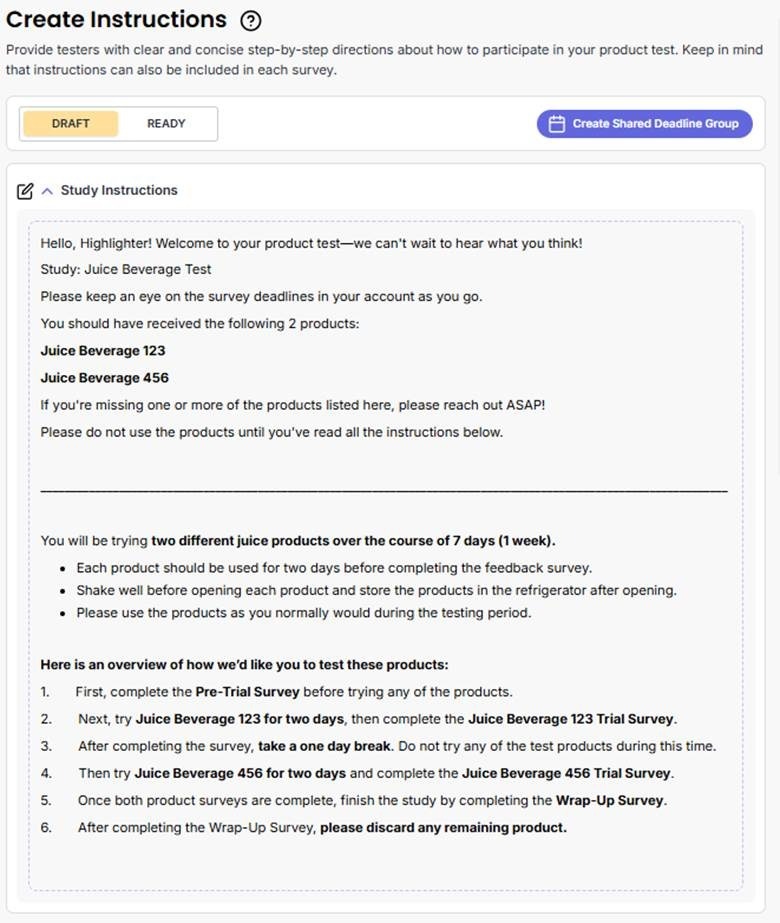
Participant instructions can be added in the Create Instructions tab on the project page.
You can include overall study instructions in the Study Instructions section, which provides participants with an overview of the study and what to expect.
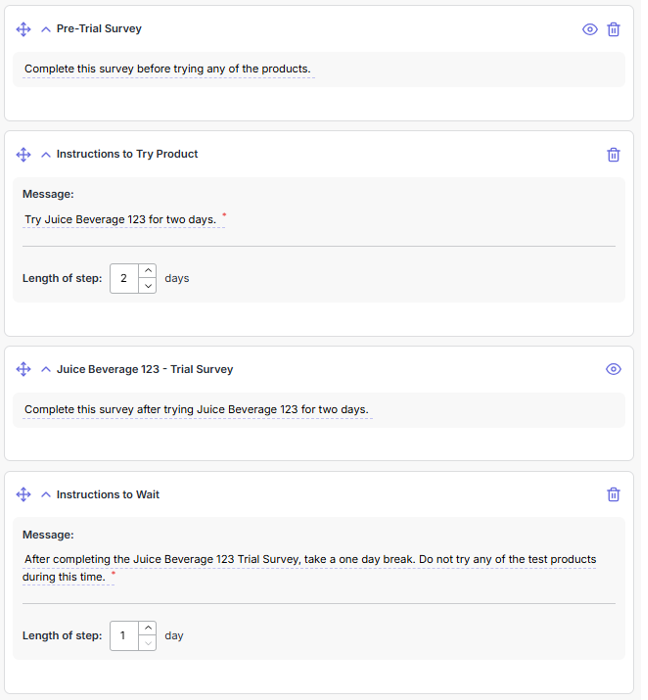
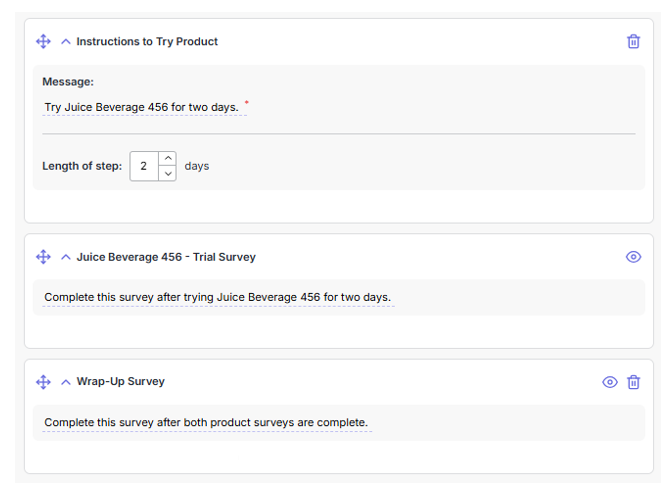
More detailed instructions can also be added within individual study steps, including:
- The message section for each survey, where you can provide instructions related to that specific survey
- Custom Instruction steps, such as Instructions to Try Product or Instructions to Wait, which allow you to guide participants on when to test products or take breaks
The example below shows how participant instructions can be added across these different sections of the platform.
Key Takeaway
Clear participant instructions help ensure that all participants test products in a consistent way. This reduces variability caused by differences in usage, timing, or storage, and leads to more reliable research results.